
#commoncomputingmethodologies 搜尋結果

List of Common Computing Methodologies to Use in Graduate-Level Computer Science Dissertation #CommonComputingMethodologies #ComputerScienceDissertation articlecluster.com/list-of-common…

Interesting work, JCIM! I wonder if these methods can truly capture real-world complexities, no? I shared a quick take here: x.com/codewithimansh…
How to Start Learning AI Agents 🤖📘 Want to get into AI Agents but don’t know where to start? Here’s your roadmap, from GenAI & RAG basics to Advanced Agent Skills 🚀 Also I’ve compiled 1000+ Materials, including AI Agents, LLMs, RAG, Prompt Engineering & Automation Guides 💼…


Fascinating read (read the earlier versions and discussed briefly with @PerryMarshall after your Lex appearance). This paper parallels @CynthiaRudin’s work in AI: both champion parsimony and interpretability, rejecting the idea that 'more complex is always better.' It reveals…

𝗖𝗼𝗺𝗽𝘂𝘁𝗲𝗿 𝘀𝗰𝗶𝗲𝗻𝗰𝗲 𝗽𝗿𝗶𝗻𝗰𝗶𝗽𝗹𝗲𝘀 (cheat code) 🔹 𝗛𝗮𝘀𝗵𝗶𝗻𝗴 – to get constant-time key lookups, e.g. user sessions in a cache. 🔹 𝗦𝗼𝗿𝘁𝗶𝗻𝗴 – to get fast binary search, e.g. lookup in a sorted list of IDs. 🔹 𝗜𝗻𝗱𝗲𝘅𝗶𝗻𝗴 / 𝗕-𝘁𝗿𝗲𝗲𝘀 – to get…

8/17 Reasoning Styles: Compares direct debugging, zero-shot step-by-step analysis (ZCoT), few-shot learning from examples (NCoT), and analogical problem-solving (AP), sometimes fresh analysis outperforms example-based approaches despite added context.

We show that it is applicable to 1. finite-sum settings: L-SVRG, SAGA, PAGE, ZeroSARAH; 2. distributed settings: EF-21, DIANA, DASHA; 3. coordinate methods: SEGA, JAGUAR

Combo model: averaging together the A/B/C models. I am very happy with combining each independent optimization solution into 1. If you know about random processes, it will make sense why averaging guesses together is good. This will be my go-to for the foreseeable future.💜


this is probably the most coherent summary of what I've been working on at common.tools for the last year excited to see what the world looks like as more folks start building with these principles in mind 🤗
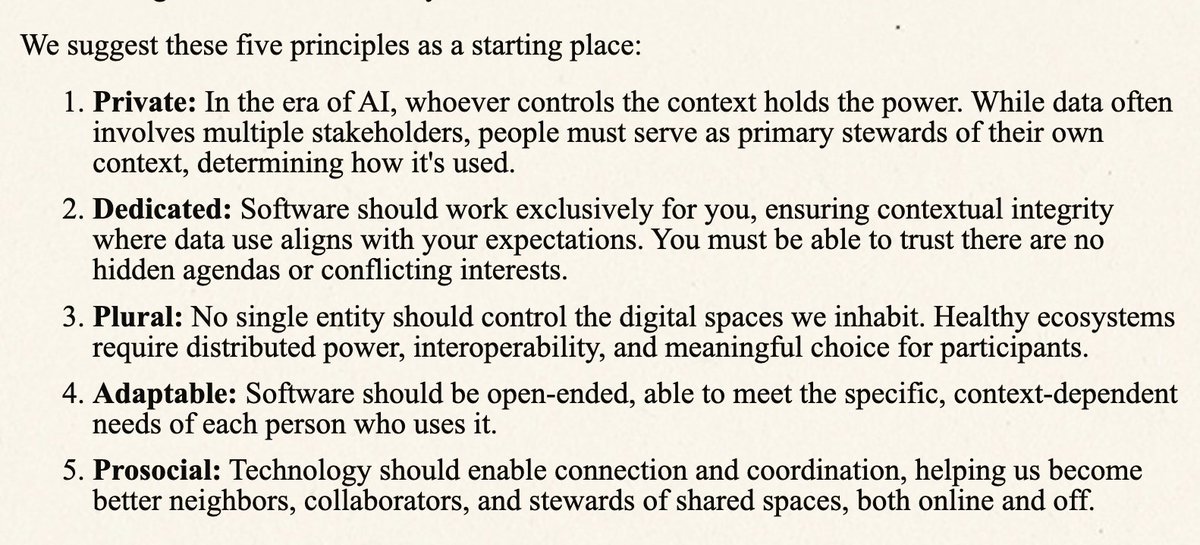

What if technology didn’t feel so… hollow? Some friends and I just released a manifesto about a world where tech leaves us feeling nourished (along with an evolving list of theses about how we can build it) resonantcomputing.org


Simple answer is simplicity, simple algorithm. No complex data normalization, mostly single threaded, simple algorithm, and lastly in-memory storage.

Collective Intelligence builds on a hypothesis. It uses stigmergy: agents communicate through a shared environment, not direct messaging. Declare what each agent consumes and produces. The system handles the rest—parallel execution, dependency resolution, validation loops—all…


IF IT ALL ADDS UP TO YOU, YOU'RE LIKELY USING COMMON CORE MATH

So we have had NO updates on the Pipe Bomber case for 5 years, then independent reporters determine that it was most likely a Capitol Police / CIA operative, and a week later we have an arrest of a random "anarchist"? Incredible.

New blog post on applying a common CUDA programming pattern - that is used in FlashAttention, for example - to the canonical problem of speeding up matrix multiplication!

And it's about consistency. Everyone gets the same results from the same inputs. No "works on my machine" because everyone's using the same cached artifacts. This is what happens when you treat computation as a shared resource, not an isolated process.

Common Task Framework For a Critical Evaluation of Scientific Machine Learning Algorithms. arxiv.org/abs/2510.23166

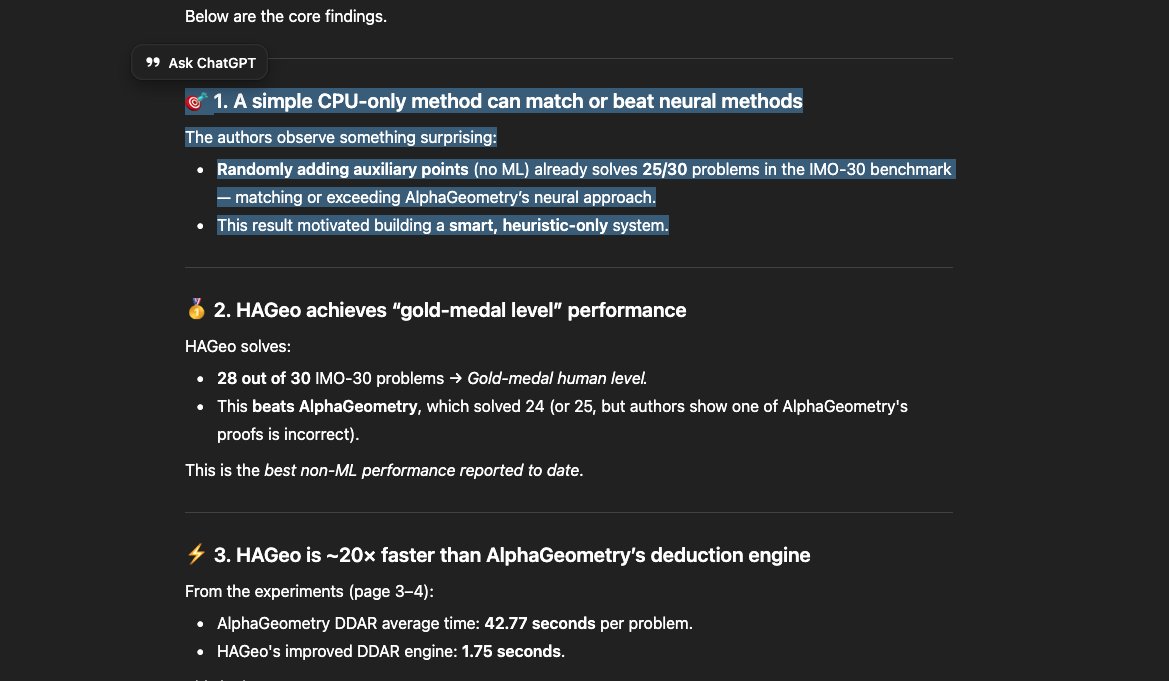
🎯 1. A simple CPU-only method can match or beat neural methods Randomly adding auxiliary points (no ML) already solves 25/30 problems in the IMO-30 benchmark — matching or exceeding AlphaGeometry’s neural approach. #interesting #cool #muchtoconsider

📄 A comparison of techniques for solving the Poisson equation in CFD by Nick Brown et al. #HPC #HighPerformanceComputing #DistributedComputing arxiv.org/abs/2010.14132…

Model-Based Diagnosis with Multiple Observations: A Unified Approach for C Software and Boolean Circuits. arxiv.org/abs/2512.02898

Satya Mandal: Methods in complete intersections in corank one arxiv.org/abs/2512.02373 arxiv.org/pdf/2512.02373 arxiv.org/html/2512.02373

Common Structure Discovery in Collections of Bipartite Networks: Application to Pollination Systems. arxiv.org/abs/2512.01716

SIMPLE: Disaggregating Sampling from GPU Inference into a Decision Plane for Faster Distributed LLM Serving. arxiv.org/abs/2512.00719
Something went wrong.
Something went wrong.
United States Trends
- 1. Jalen 70.4K posts
- 2. Eagles 113K posts
- 3. Herbert 32.4K posts
- 4. AJ Brown 9,830 posts
- 5. #BoltUp 4,481 posts
- 6. #WWERaw 47.5K posts
- 7. Saquon 11.3K posts
- 8. Sirianni 5,472 posts
- 9. Patullo 6,915 posts
- 10. #PHIvsLAC 3,740 posts
- 11. Tony Jefferson 2,920 posts
- 12. Cam Hart 1,292 posts
- 13. Cameron Dicker 1,788 posts
- 14. 4 INTs 3,332 posts
- 15. LA Knight 10K posts
- 16. Tanner McKee 1,606 posts
- 17. Jordan Davis 1,131 posts
- 18. Dotson 1,981 posts
- 19. Greg Roman 1,420 posts
- 20. Smitty 3,112 posts