
#typescriptdatatypes 搜尋結果

For example this is answer from backend. Objects like {data: any, pagination: Record<>} or {error: string, someOtherStuff: any} This is what I met in my real work. Axios has (almost) the same types IIRC. Or more realistic examples in the thread github.com/Microsoft/Type…


New --inline-types flag (-I) Generate TypeScript types directly in your schema file: export const userSchema = z.object({ ... }); export type User = z.infer<typeof userSchema>; One file. No separate .d.ts needed.

alguns conceitos pra elevar >MUITO< o seu nível em typescript: - assignability (set theory) - conditional types (distributive and non distributive) - derived types - mapped types (mapping modifiers, homomorphic, non-homomorphic, key remapping) - reverse mapped types - infer…

pô man trabalho com ts a tempos tbm e sinto que poderia melhorar, tem indicação de conteúdo pra dá esse passo?

TypeScript was created to improve JavaScript by adding static types. And if you've been wanting to learn it, start here with this TS handbook from @stephenjyd. You'll learn about type annotations, type inference, the union and any types, objects, function params, type aliases,…

TypeScript was created to improve JavaScript by adding static types. And if you've been wanting to learn it, start here with this TS handbook from @stephenjyd. You'll learn about type annotations, type inference, the union and any types, objects, function params, type aliases,…


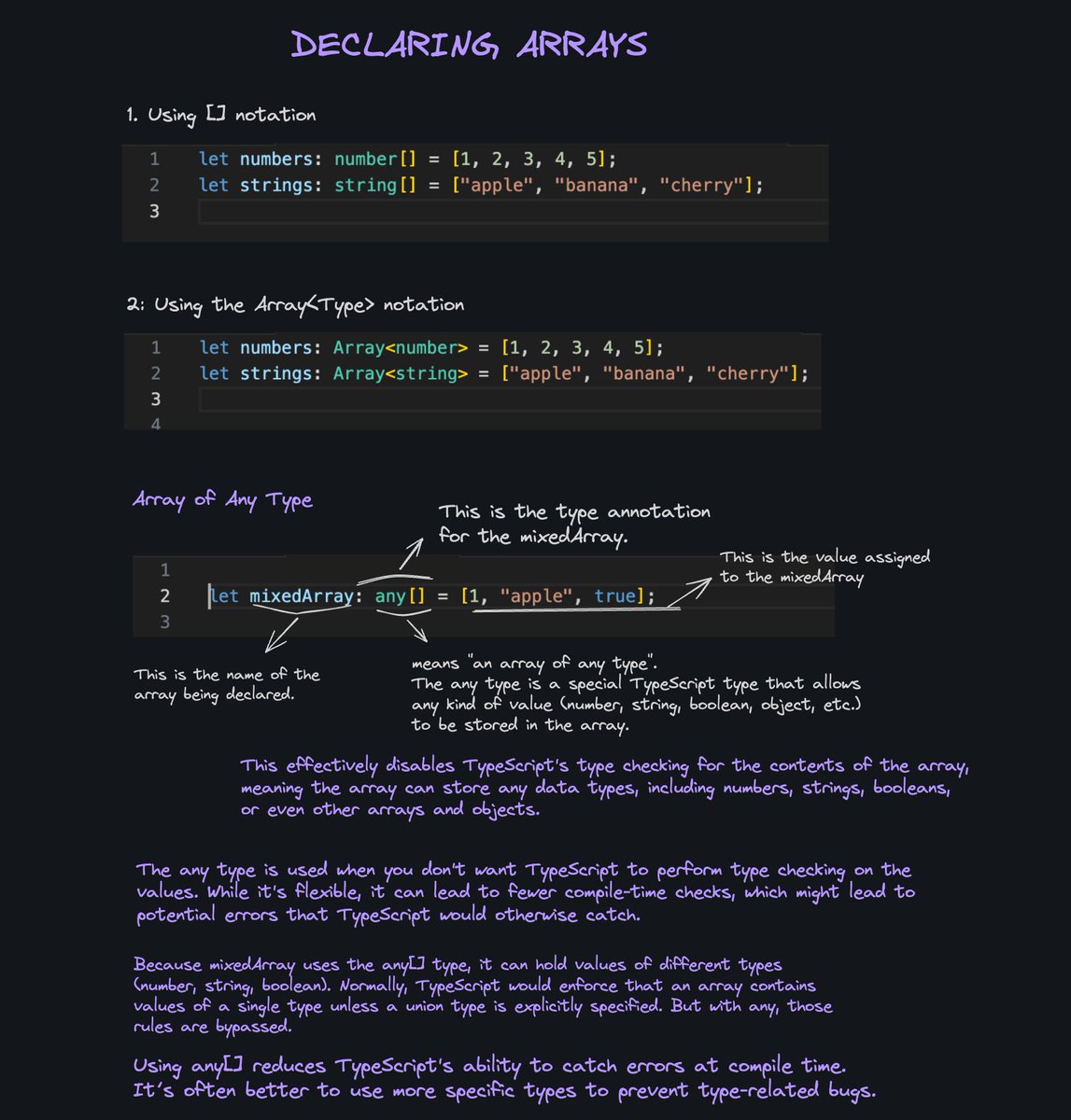
Arrays in TypeScript: An array is a data structure that allows you to store multiple values (elements) of the same or different types in a single variable. Arrays are a collection of values indexed by numbers, starting from 0. TypeScript provides support for arrays just like…


TypeScript is a superset of JavaScript that has become quite popular among devs. In this in-depth guide, @Clifftech_Dev teaches you TS basics to get you started. He helps you install it, and explains type declarations, interfaces, generics, & lots more. freecodecamp.org/news/typescrip…


みんな誰も突っ込まないんだけど、TypeScriptってそもそもintやfloatがnumberに集約されているし、charもstringに集約されているので、アトミックな型が弱い。

Naming your types is a tricky business, and it's WILDLY inconsistent per project. Let's set down some rules to help avoid confusion/irritation/laptop defenestration. totaltypescript.com/tips/how-to-na…


TypeScript tip: Prefer type declarations to type assertions. Type assertions ignore excess properties. 👎 Type declarations check for excess properties. 👍 Plus, only type declarations provide autocomplete support as you declare the object literal. #typescript

🧙♂️NEW TS REPO 🧙♂️ To truly master TypeScript, you need to know how to transform a type to ANY OTHER type. These 35 exercises cover template literal types, infer, conditional types, key remapping, discriminated unions, and much more. And it's free! github.com/total-typescri…

In TypeScript, you can create a custom function to check an object's type. This is called a "User Defined Type Guard" The function returns true if the argument passed appears to be the expected type. This is a handy way to "narrow" types on plain JS objects. #typescript


🔥 You can use TypeScript's `typeof` along with the `ReturnType<>` utility method to dynamically get the type that a method returns. In my case, this setInterval returns a number in browserland, but NodeJS.Timer in node.

🔥 TypeScript Tip #13 🔥 Want to turn a module into a type? You can use typeof import('./') to grab the type of any module, even third-party ones. Here, we create a type from a constants.ts file, then map over the values to create a union.

TypeScript tip: Version 4.1 brings enhancement over the string literal types that allow you to generate new literals using JavaScript template literal syntax 📚 Read more devblogs.microsoft.com/typescript/ann…


💡 TypeScript tip: TypeScript infers array's type as an Array of the union of included types... which may not be precise enough. If you want this value to be inferred as a Tuple instead, add `as const`

⚛️📜Getting into Typescript from React can be tricky, and resources are all over the place. I put together a cheatsheet for people to refer to! Please help to contribute examples and common React + Typescript patterns! cc: @browniefed @jaredpalmer github.com/sw-yx/react-ty…


Ever wondered how to write modern declaration files for TypeScript 2.0+? Read up on how to author for #@types. blogs.msdn.microsoft.com/typescript/201…

Discriminated union types now in TypeScript 2.0 master branch. github.com/Microsoft/Type… #typescript @typescriptlang
github.com
Discriminated union types by ahejlsberg · Pull Request #9163 · microsoft/TypeScript
This PR implements support for discriminated union types, inspired by suggestions in #186 and #1003. Specifically, we now support type guards that narrow union types based on tests of a discriminan...
Something went wrong.
Something went wrong.
United States Trends
- 1. Greg Biffle 26.1K posts
- 2. Kennedy Center 16K posts
- 3. Hunger Games 10.4K posts
- 4. Statesville 17.2K posts
- 5. President Kennedy 6,429 posts
- 6. Helene 11.7K posts
- 7. Cleetus 1,257 posts
- 8. FINALLY DID IT 443K posts
- 9. NextNRG 3,255 posts
- 10. Garrett Mitchell 2,824 posts
- 11. #NASCAR 1,740 posts
- 12. Schedule I to Schedule III 4,506 posts
- 13. Jason Kidd 1,709 posts
- 14. Puka 19.8K posts
- 15. Patriot Games 2,293 posts
- 16. Adin Ross 4,220 posts
- 17. #jonita 18.9K posts
- 18. Western NC 2,429 posts
- 19. Ryder 29K posts
- 20. Marijuana 20.7K posts