

World of SQL
@SQL_feed
Learn. Query. Automate. | Daily SQL tips & data wisdom.
You might like


Learn SQL the simple, visual, and practical way. Clear concepts. Real-world examples. Python + SQL. Automation. Everything you need to level up your data skills. Follow @SQL_feed.
Python + SQL is one of the most useful skills in data work. Python doesn’t replace SQL, it automates everything around it. Here’s what Python can automate for you: • Running recurring SQL queries • Loading results into Pandas/DataFrames • Cleaning and transforming data •…
When to Use Each Python SQL Library 🔹 SQLAlchemy — Use it when… •You’re building an app •You want models (ORM) •You need reusable queries •You don’t want to manually write SQL every time Best for: automation, pipelines, web apps. ⸻ 🔹 Pandas (read_sql) — Use it when……
Python Libraries Every SQL User Should Know 🔹 1. SQLAlchemy The most powerful Python ORM + query builder. Used for database models, sessions, and generating SQL automatically. 🔹 2. Pandas (pd.read_sql) Pandas can run SQL queries directly and load results…
SQL is the language. SQLAlchemy is the toolbox that lets Python speak that language safely and powerfully. With SQL, you write queries. With SQLAlchemy, you build queries dynamically, programmatically, and database-agnostically. Same result. Different mindset. Perfect combo for…
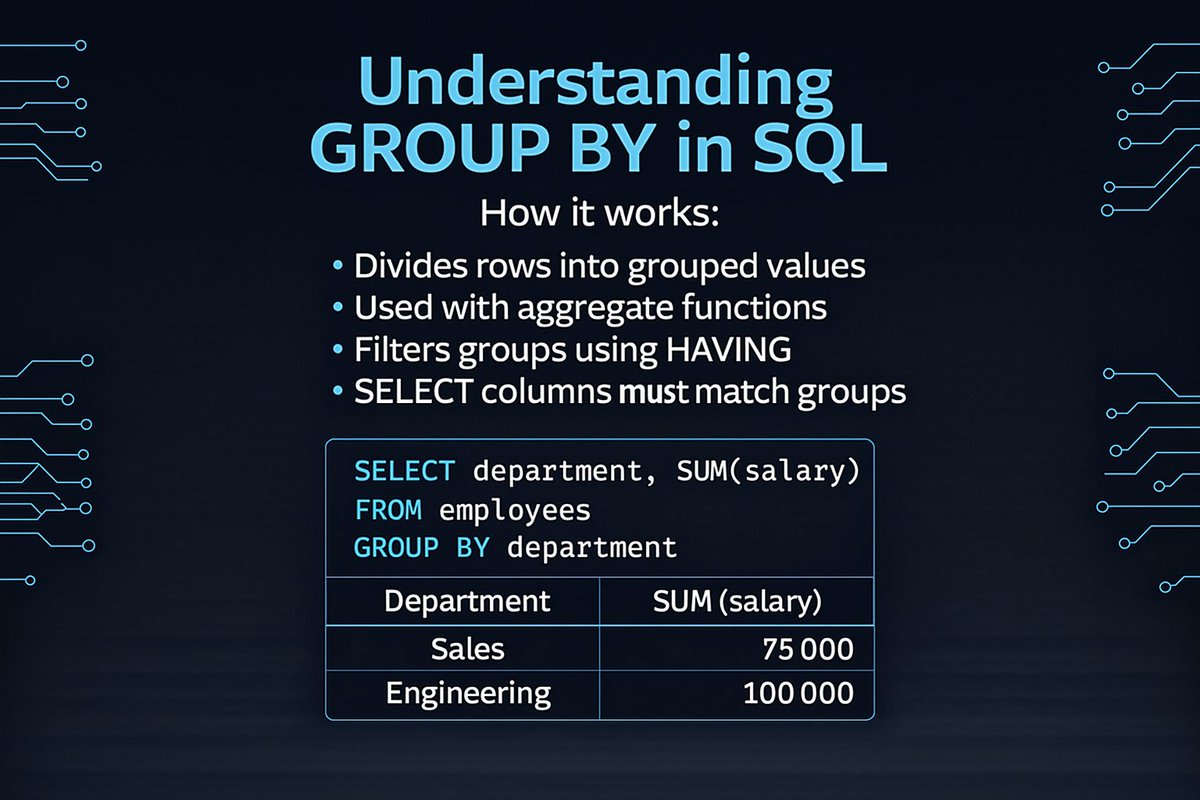
Understanding GROUP BY in SQL (Deep Dive) GROUP BY lets you summarize data by categories and it’s essential for reporting, analytics, and dashboards. Once you master GROUP BY, you can transform raw tables into real insights. 📊 #SQL #DataAnalytics #DataEngineering #LearnSQL
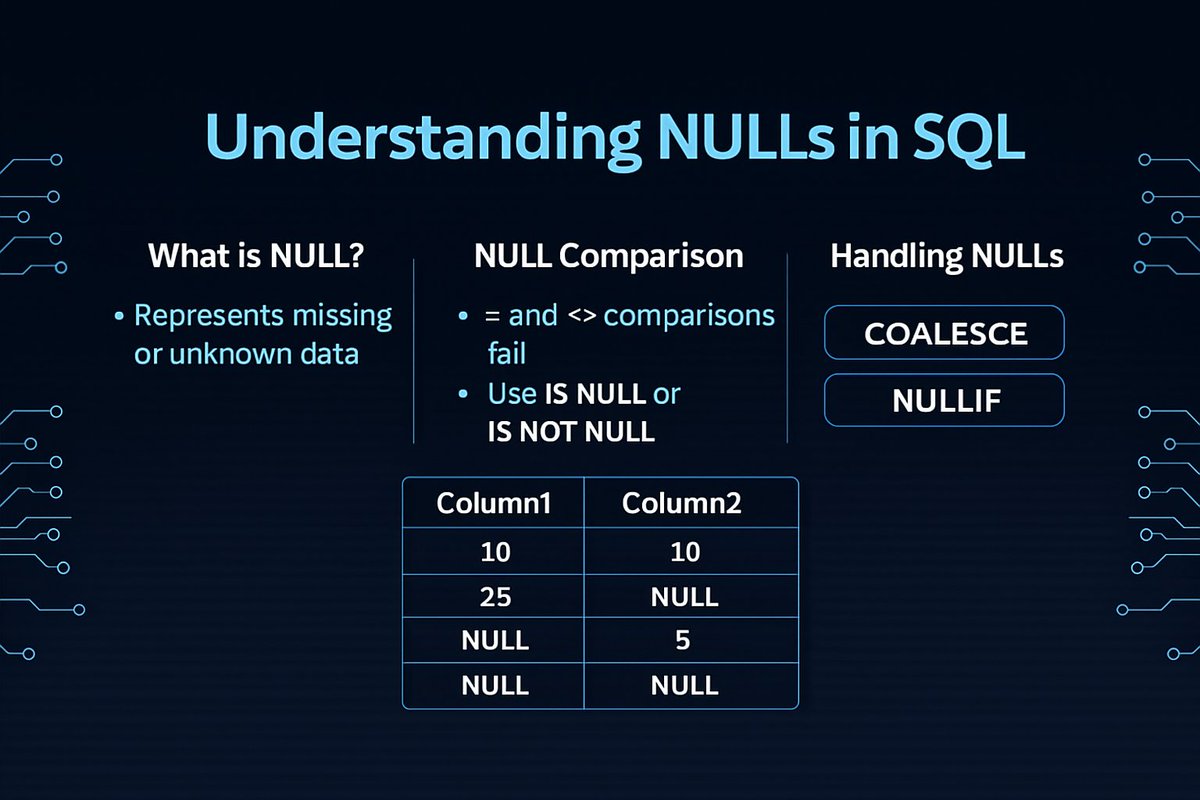
Understanding NULLs in SQL - What They REALLY Mean NULL isn’t zero. NULL isn’t empty. NULL means “unknown” and it behaves differently from any other value in SQL. Here’s what to remember: = and <> don’t work with NULL Always use IS NULL / IS NOT NULL Functions like COALESCE…
COALESCE in SQL - Handle NULLs the Smart Way COALESCE() returns the first non-NULL value in a list. It’s one of the simplest and most powerful tools for cleaning data. Use it to: - Replace NULLs with defaults - Prevent calculation errors - Keep reports clean - Evaluate multiple…

The Anatomy of a SELECT Query (Deep Dive) Every SQL query follows a predictable structure. Once you understand the order of each clause, writing clean queries becomes effortless. Here’s the full flow: SELECT → choose columns FROM → choose table WHERE → filter rows GROUP BY…
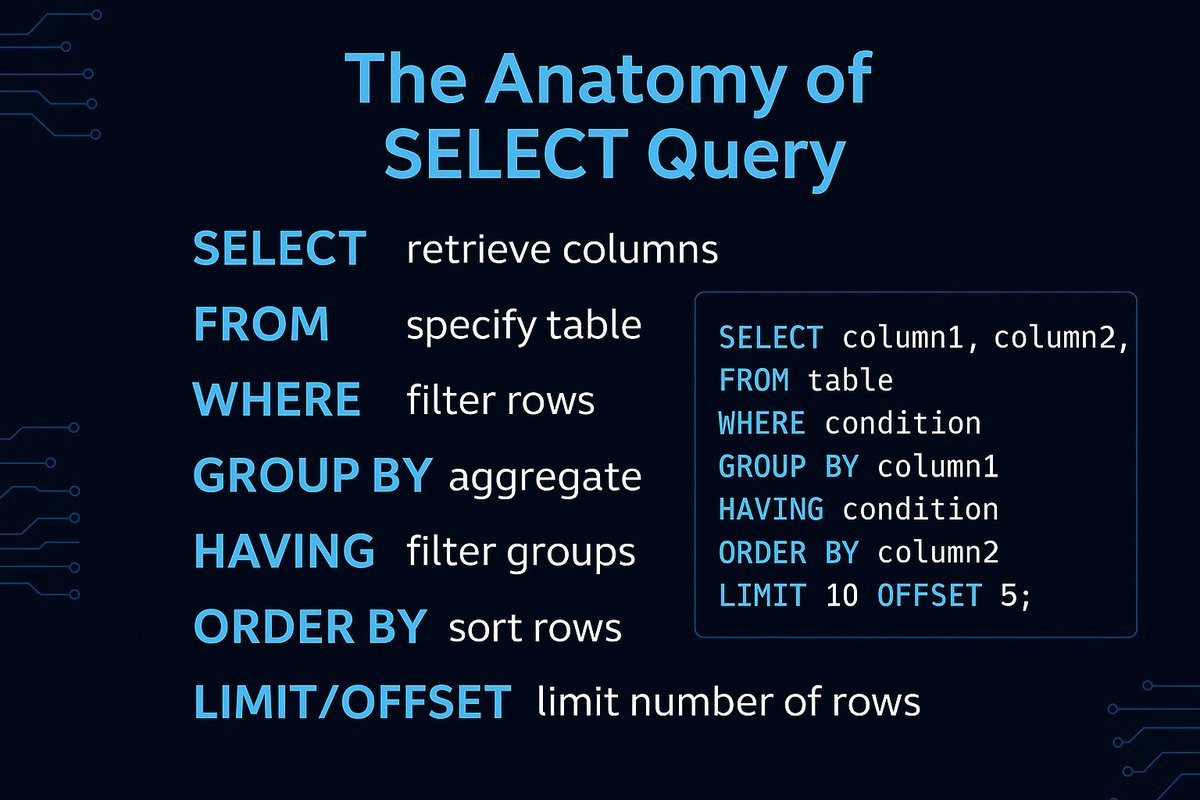
SELECT in SQL - Your Most Important Command Every SQL journey starts with SELECT. It lets you extract exactly the data you need - columns, filters, ordering, and more. Mastering SELECT is the first step toward mastering SQL. #SQL #DataAnalytics #DataEngineering #LearnSQL

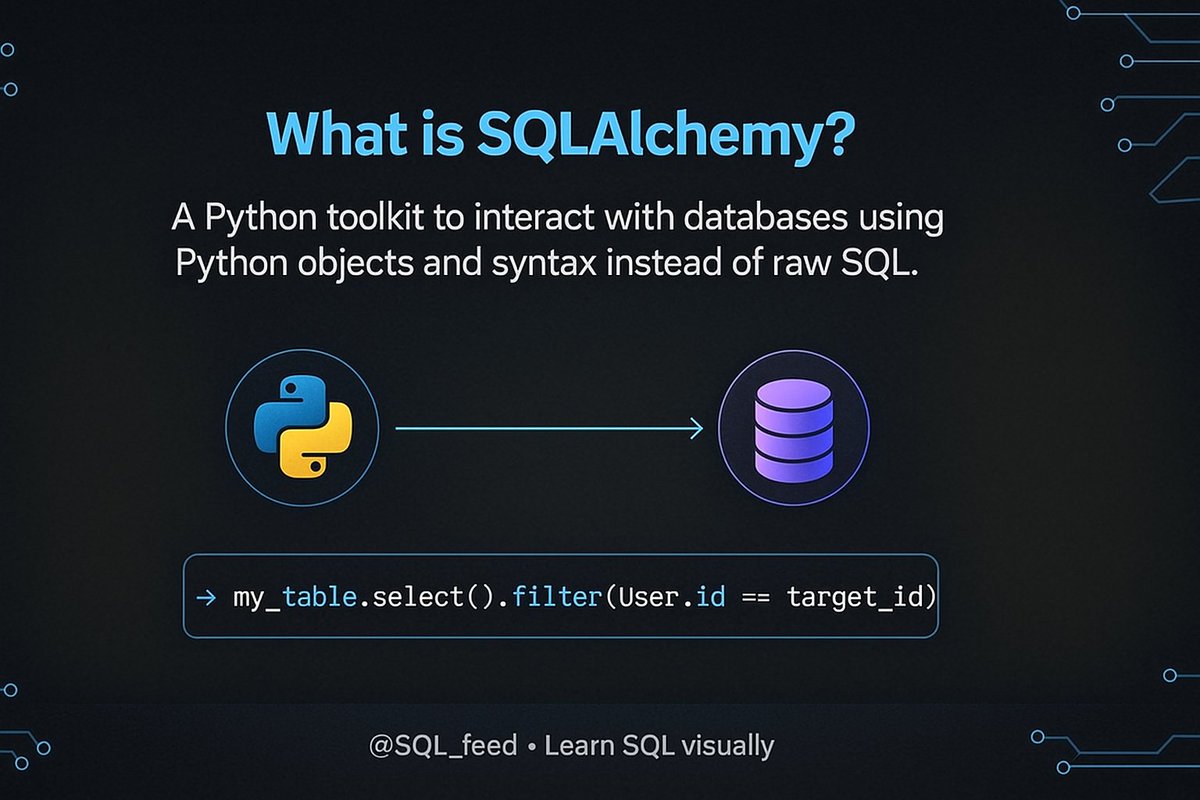
What is SQLAlchemy? SQLAlchemy lets you work with databases like writing Python code, not raw SQL. It’s perfect when you want: - Cleaner, more readable queries - Python objects instead of strings - Safer database interactions - A scalable way to build data apps If you use…
Why Analysts Use Python with SQL SQL gets the data. Python transforms it. Together → they create powerful, automated, repeatable workflows. If you want to level up as an analyst, learning both is a game-changer. #SQL #Python #DataEngineering #DataAnalytics

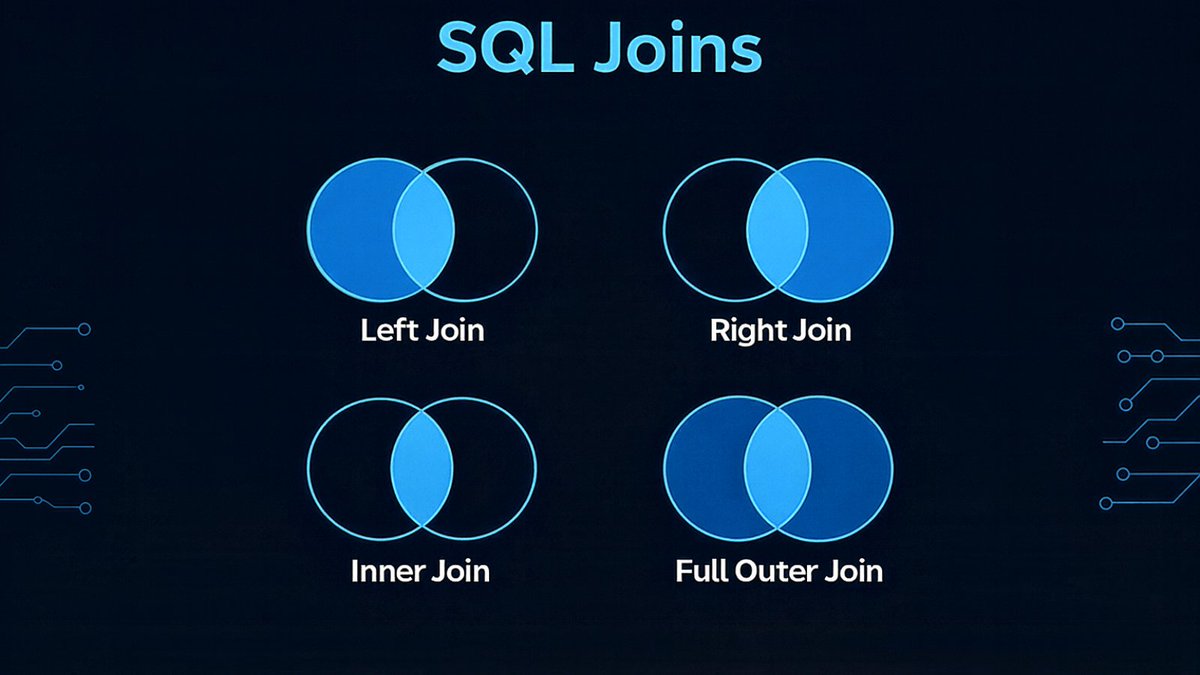
SQL Joins Explained (Visual Guide) Understanding joins is essential for working with relational databases: Left Join → All rows from the left table + matches from the right Right Join → All rows from the right table + matches from the left Inner Join → Only matching rows…
Common SQL Mistake: WHERE vs. HAVING WHERE filters rows before aggregation. HAVING filters after aggregation. If you’re using COUNT(), SUM(), AVG(), etc. → You almost always need HAVING, not WHERE. Master this and you’ll avoid one of the easiest SQL traps. #SQL…

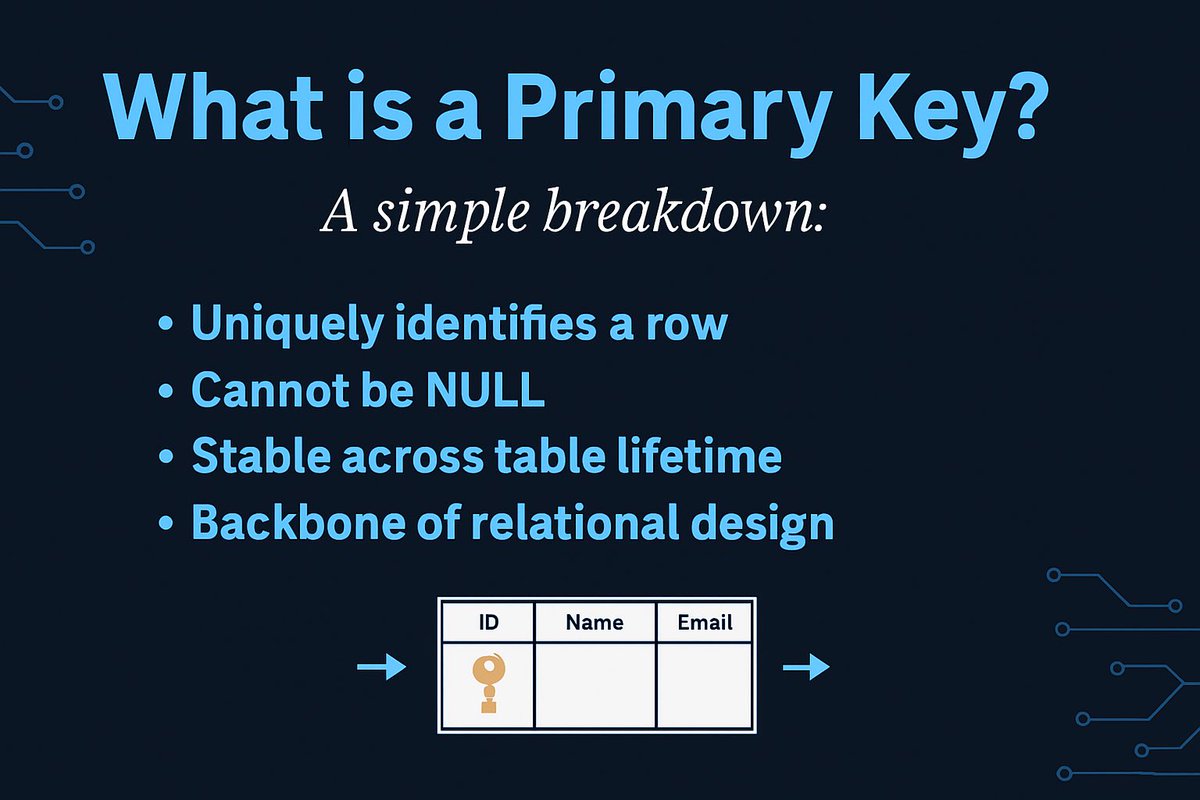
What is a Primary Key (PK)? A simple rule: every table needs one. It uniquely identifies each row and keeps your data structured, stable, and relational. Master this concept → you instantly understand 50% of SQL design. #SQL #DataEngineering #DataAnalytics
Window functions aren’t “advanced”, they’re your superpower once you learn them. Here’s the mental model: •GROUP BY → compresses rows •Window functions → keep rows and add calculations •Perfect for: rankings, running totals, moving averages, comparisons If you’re doing…









































































United States Trends
- 1. Chiefs 112K posts
- 2. Mahomes 43.5K posts
- 3. Bills 140K posts
- 4. Philip Rivers 26.9K posts
- 5. Broncos 35.9K posts
- 6. Patriots 132K posts
- 7. Josh Jacobs 8,696 posts
- 8. Riley Moss 1,600 posts
- 9. Rams 14.9K posts
- 10. Seahawks 22.1K posts
- 11. Chargers 67.2K posts
- 12. Australia 1.6M posts
- 13. Pats 23.2K posts
- 14. Watson 11.5K posts
- 15. Raiders 38.1K posts
- 16. Bo Nix 3,615 posts
- 17. Drake Maye 26.8K posts
- 18. #GoPackGo 5,054 posts
- 19. Jordan Love 14.3K posts
- 20. Happy Hanukkah 21.3K posts




Something went wrong.
Something went wrong.