
unix_byte's profile picture. Book "Understanding Linux: The Kernel Perspective" http://leanpub.com/linuxkernel/
Amazon: https://www.amazon.com/dp/B0FCBKCGGC

v1.15 now released

Understanding Linux: The Kernel Perspective

@unix_byte

Book "Understanding Linux: The Kernel Perspective" http://leanpub.com/linuxkernel/ Amazon: https://www.amazon.com/dp/B0FCBKCGGC v1.15 now released

置顶

AT&T Archives: The creators of UNIX talk about UNIX, circa 1980 John Mashey (of Mashey Shell) talks at 1:30 Brian Kernighan (K in 'awk') talks at 4:11 Ken Thompson and Dennis Ritchie appear together at 4:48 Ken Thompson talks at 13:00 youtube.com/watch?v=tc4ROC…

unix_byte's tweet image. AT&T Archives: The creators of UNIX talk about UNIX, circa 1980
John Mashey (of Mashey Shell) talks at 1:30
Brian Kernighan (K in 'awk') talks at 4:11
Ken Thompson and Dennis Ritchie appear together at 4:48
Ken Thompson talks at 13:00
youtube.com/watch?v=tc4ROC…
unix_byte's tweet image. AT&T Archives: The creators of UNIX talk about UNIX, circa 1980
John Mashey (of Mashey Shell) talks at 1:30
Brian Kernighan (K in 'awk') talks at 4:11
Ken Thompson and Dennis Ritchie appear together at 4:48
Ken Thompson talks at 13:00
youtube.com/watch?v=tc4ROC…
unix_byte's tweet image. AT&T Archives: The creators of UNIX talk about UNIX, circa 1980
John Mashey (of Mashey Shell) talks at 1:30
Brian Kernighan (K in 'awk') talks at 4:11
Ken Thompson and Dennis Ritchie appear together at 4:48
Ken Thompson talks at 13:00
youtube.com/watch?v=tc4ROC…
unix_byte's tweet image. AT&T Archives: The creators of UNIX talk about UNIX, circa 1980
John Mashey (of Mashey Shell) talks at 1:30
Brian Kernighan (K in 'awk') talks at 4:11
Ken Thompson and Dennis Ritchie appear together at 4:48
Ken Thompson talks at 13:00
youtube.com/watch?v=tc4ROC…

A real-time operating system (RTOS) is defined by its ability to meet strict and predictable timing determined by worst-case latency. Traditional real-time OSes such as VxWorks, FreeRTOS, or QNX are designed from the ground up so that high-priority tasks preempt lower-priority…

unix_byte's tweet image. A real-time operating system (RTOS) is defined by its ability to meet strict and predictable timing determined by worst-case latency. Traditional real-time OSes such as VxWorks, FreeRTOS, or QNX are designed from the ground up so that high-priority tasks preempt lower-priority…

Virtual Memory Areas (VMAs) are fundamental to Linux memory management. This is the core abstraction that makes Linux memory management scalable and efficient: instead of treating a process’s address space as millions of individual pages, the kernel represents it as a set of…

unix_byte's tweet image. Virtual Memory Areas (VMAs) are fundamental to Linux memory management. This is the core abstraction that makes Linux memory management scalable and efficient: instead of treating a process’s address space as millions of individual pages, the kernel represents it as a set of…

The Memory Management Unit (MMU) is not a chip—it's a function. Despite common belief, the MMU is not a single physical chip or even a single well-defined block of logic on a modern CPU die. Instead, “MMU” refers to a distributed set of translation and protection mechanisms…

unix_byte's tweet image. The Memory Management Unit (MMU) is not a chip—it's a function.

Despite common belief, the MMU is not a single physical chip or even a single well-defined block of logic on a modern CPU die. Instead, “MMU” refers to a distributed set of translation and protection mechanisms…

On Intel and AMD x86-64 systems, the Memory Management Unit (MMU) is architecturally fixed to use a 4 KiB base page size. This design is inherited from the Intel 80386 processor from 1985, whose paging structures, entry formats, and alignment rules all assumed 4 KiB pages. For…
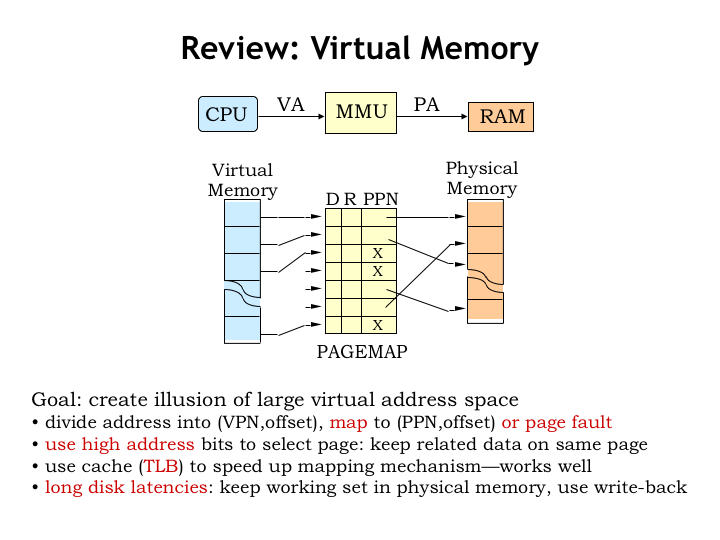
unix_byte's tweet image. On Intel and AMD x86-64 systems, the Memory Management Unit (MMU) is architecturally fixed to use a 4 KiB base page size. This design is inherited from the Intel 80386 processor from 1985, whose paging structures, entry formats, and alignment rules all assumed 4 KiB pages. For…

BYTE from Nov 1984 reviewed the Soviet Agat (АГАТ) microcomputer, often described as the USSR’s first mass-produced personal computer, in rather unflattering terms, noting its technical limitations, architectural quirks, and generally lagging behind Western standards. For much of…

unix_byte's tweet image. BYTE from Nov 1984 reviewed the Soviet Agat (АГАТ) microcomputer, often described as the USSR’s first mass-produced personal computer, in rather unflattering terms, noting its technical limitations, architectural quirks, and generally lagging behind Western standards. For much of…

The IBM RS/6000 product line was a major early-1990s platform of high-performance RISC workstations and servers based on the POWER architecture. RS/6000 machines ran AIX, IBM’s UNIX System V–based OS with many BSD features. AIX was influential in UNIX history, supercomputing, and…

unix_byte's tweet image. The IBM RS/6000 product line was a major early-1990s platform of high-performance RISC workstations and servers based on the POWER architecture. RS/6000 machines ran AIX, IBM’s UNIX System V–based OS with many BSD features. AIX was influential in UNIX history, supercomputing, and…

In October 1988, BYTE introduced the concept of hypertext to a mainstream microcomputer audience, several years before HTML 2.0 (the first official standard) was finalised in 1995. Before this time, hypertext was primarily discussed in academic circles or associated with…

unix_byte's tweet image. In October 1988, BYTE introduced the concept of hypertext to a mainstream microcomputer audience, several years before HTML 2.0 (the first official standard) was finalised in 1995. Before this time, hypertext was primarily discussed in academic circles or associated with…

The Linux kernel authorities are currently discussing whether to enable support for Microsoft C (MSVC) language extensions. Sounds like heresy? It turns out, this is about the growing importance of the Clang compiler. The patches under review do not aim to compile Linux with…

unix_byte's tweet image. The Linux kernel authorities are currently discussing whether to enable support for Microsoft C (MSVC) language extensions. Sounds like heresy? It turns out, this is about the growing importance of the Clang compiler. The patches under review do not aim to compile Linux with…

From its inception in 1991, the Linux kernel has been developed in tandem with the GNU toolchain, specifically the GNU Compiler Collection (GCC) and GNU Binutils. Linus Torvalds wrote early kernel code relying on features unavailable in the ISO C standard or in other compilers.…

unix_byte's tweet image. From its inception in 1991, the Linux kernel has been developed in tandem with the GNU toolchain, specifically the GNU Compiler Collection (GCC) and GNU Binutils. Linus Torvalds wrote early kernel code relying on features unavailable in the ISO C standard or in other compilers.…

The early 1990s were the heyday of Perl, a language that embodied the spirit of the early web: flexible, pragmatic, and unapologetically messy. Perl quickly became the tool of choice for system administrators, CGI (Common Gateway Interface) programming, and anyone who needed to…

unix_byte's tweet image. The early 1990s were the heyday of Perl, a language that embodied the spirit of the early web: flexible, pragmatic, and unapologetically messy. Perl quickly became the tool of choice for system administrators, CGI (Common Gateway Interface) programming, and anyone who needed to…

Brian Kernighan was one of the three original authors of ‘awk’ (stands for Aho – Weinberger – Kernighan) developed in 1977 at Bell Labs. Kernighan, Aho, and Weinberger set out to develop a small interpreted language for text pattern scanning and reporting, essentially a scripting…
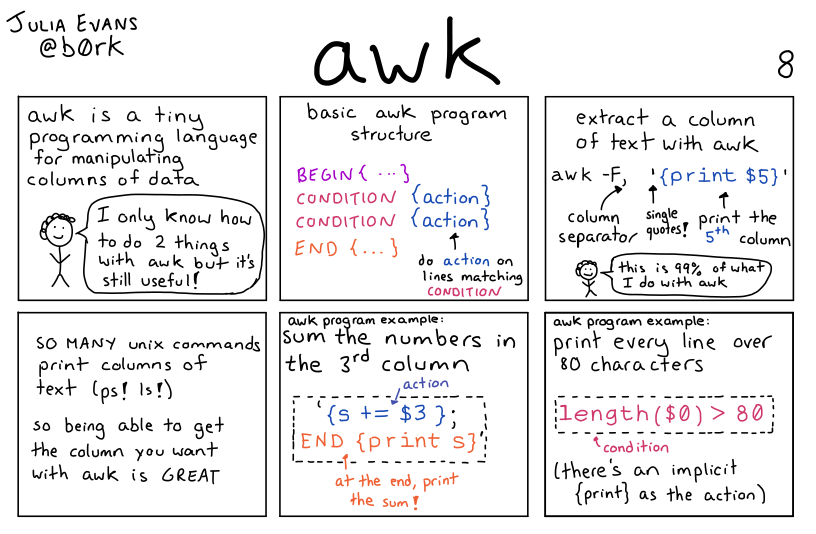
unix_byte's tweet image. Brian Kernighan was one of the three original authors of ‘awk’ (stands for Aho – Weinberger – Kernighan) developed in 1977 at Bell Labs. Kernighan, Aho, and Weinberger set out to develop a small interpreted language for text pattern scanning and reporting, essentially a scripting…

VMS (Virtual Memory System) was a landmark operating system developed by Digital Equipment Corporation (DEC) between 1975 and 1977, in conjunction with the design of the VAX (Virtual Address eXtension) architecture. Conceived as a next-generation environment to succeed the PDP-11…

unix_byte's tweet image. VMS (Virtual Memory System) was a landmark operating system developed by Digital Equipment Corporation (DEC) between 1975 and 1977, in conjunction with the design of the VAX (Virtual Address eXtension) architecture. Conceived as a next-generation environment to succeed the PDP-11…

Dan Ingalls was the principal designer and implementer of Smalltalk. Smalltalk is an immensely influential language that pioneered object-oriented programming and its execution model, which relied on a virtual machine, paved the way for modern VMs like the Java Virtual Machine…

unix_byte's tweet image. Dan Ingalls was the principal designer and implementer of Smalltalk.

Smalltalk is an immensely influential language that pioneered object-oriented programming and its execution model, which relied on a virtual machine, paved the way for modern VMs like the Java Virtual Machine…
unix_byte's tweet image. Dan Ingalls was the principal designer and implementer of Smalltalk.

Smalltalk is an immensely influential language that pioneered object-oriented programming and its execution model, which relied on a virtual machine, paved the way for modern VMs like the Java Virtual Machine…

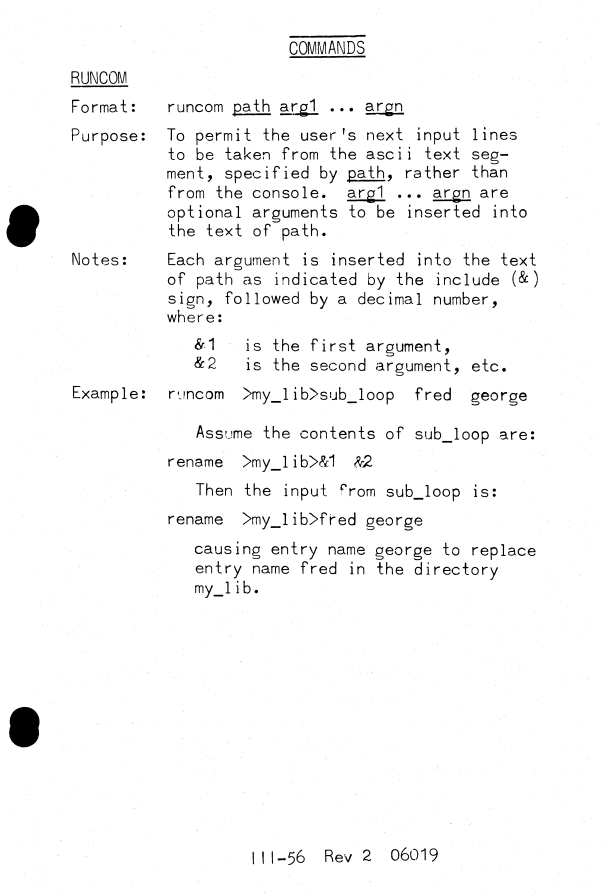
The 1969 Multics Condensed Guide shows that Multics already incorporated a number of features foundational to the development of Unix. The Multics command interpreter was designed by Louis Pouzin and Glenda Schroeder; a key innovation was that the command interpreter operated as…
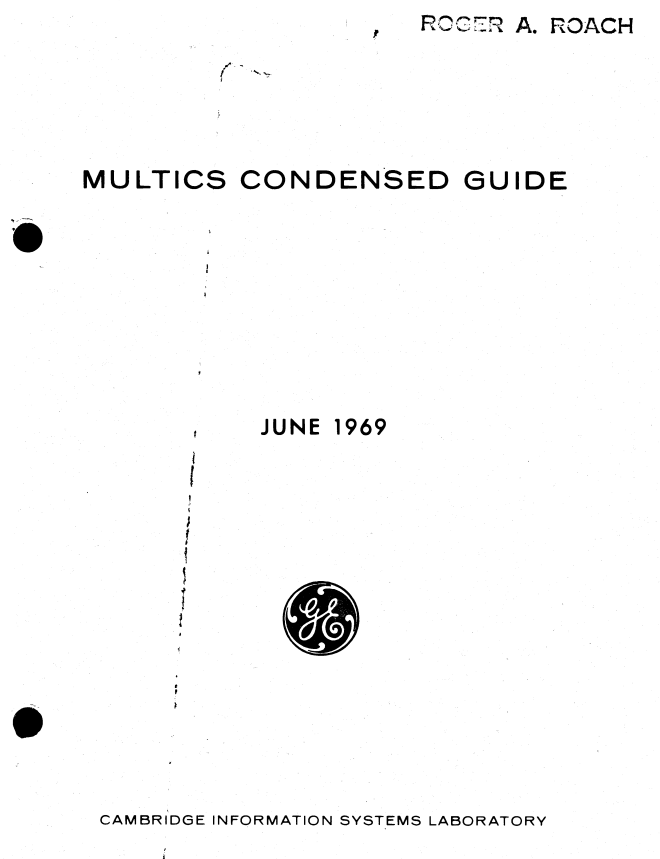
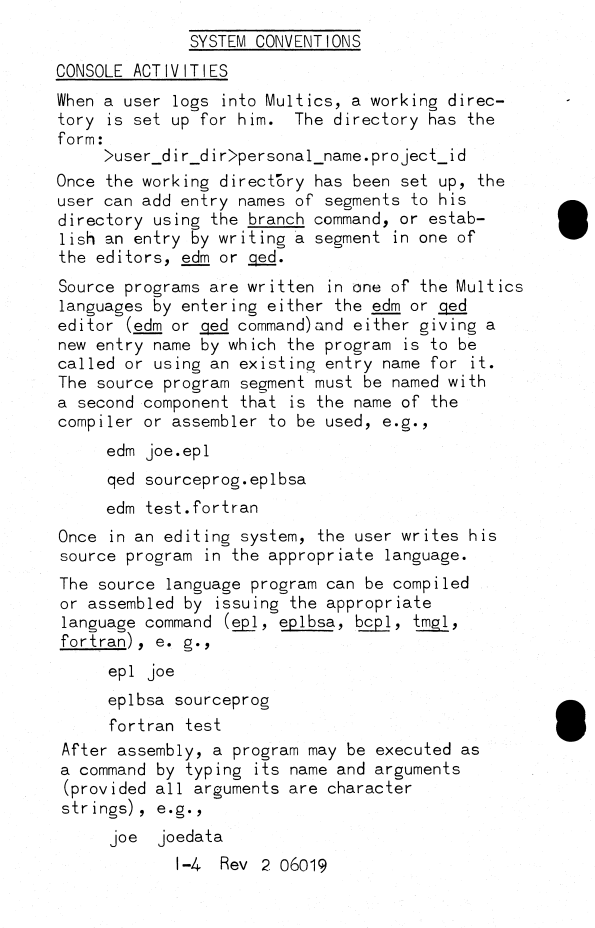
unix_byte's tweet image. The 1969 Multics Condensed Guide shows that Multics already incorporated a number of features foundational to the development of Unix. The Multics command interpreter was designed by Louis Pouzin and Glenda Schroeder; a key innovation was that the command interpreter operated as…

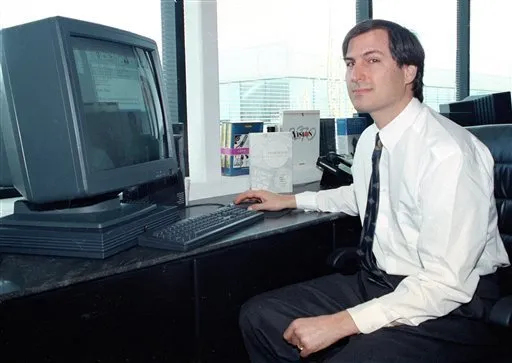
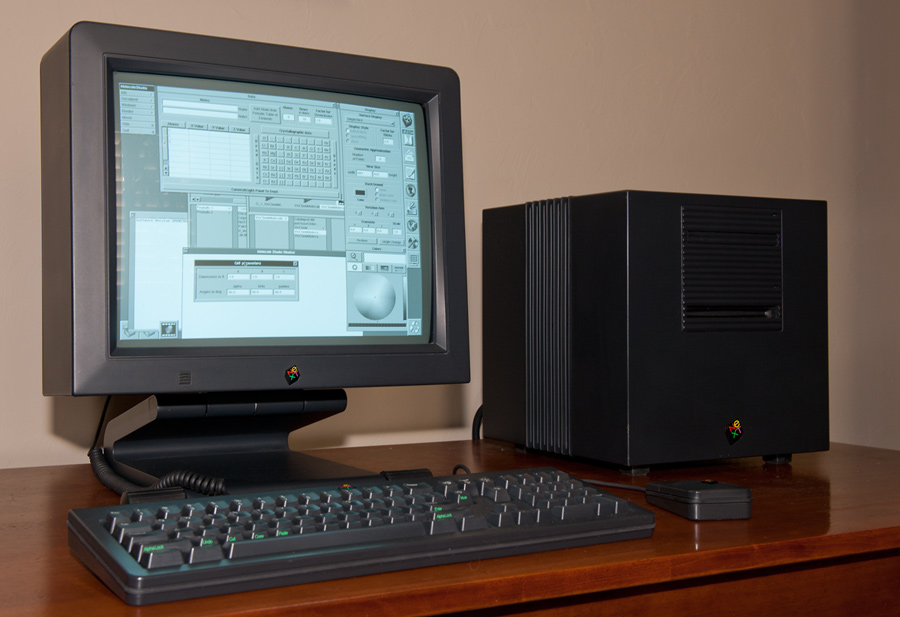
In 1993, Steve Jobs was largely absent from public following his departure from Apple in 1985. Jobs had founded NeXT, a company that produced high-end Unix workstations, but it struggled commercially. The entry-level NeXT workstation was priced around $5,000—approximately $15,000…
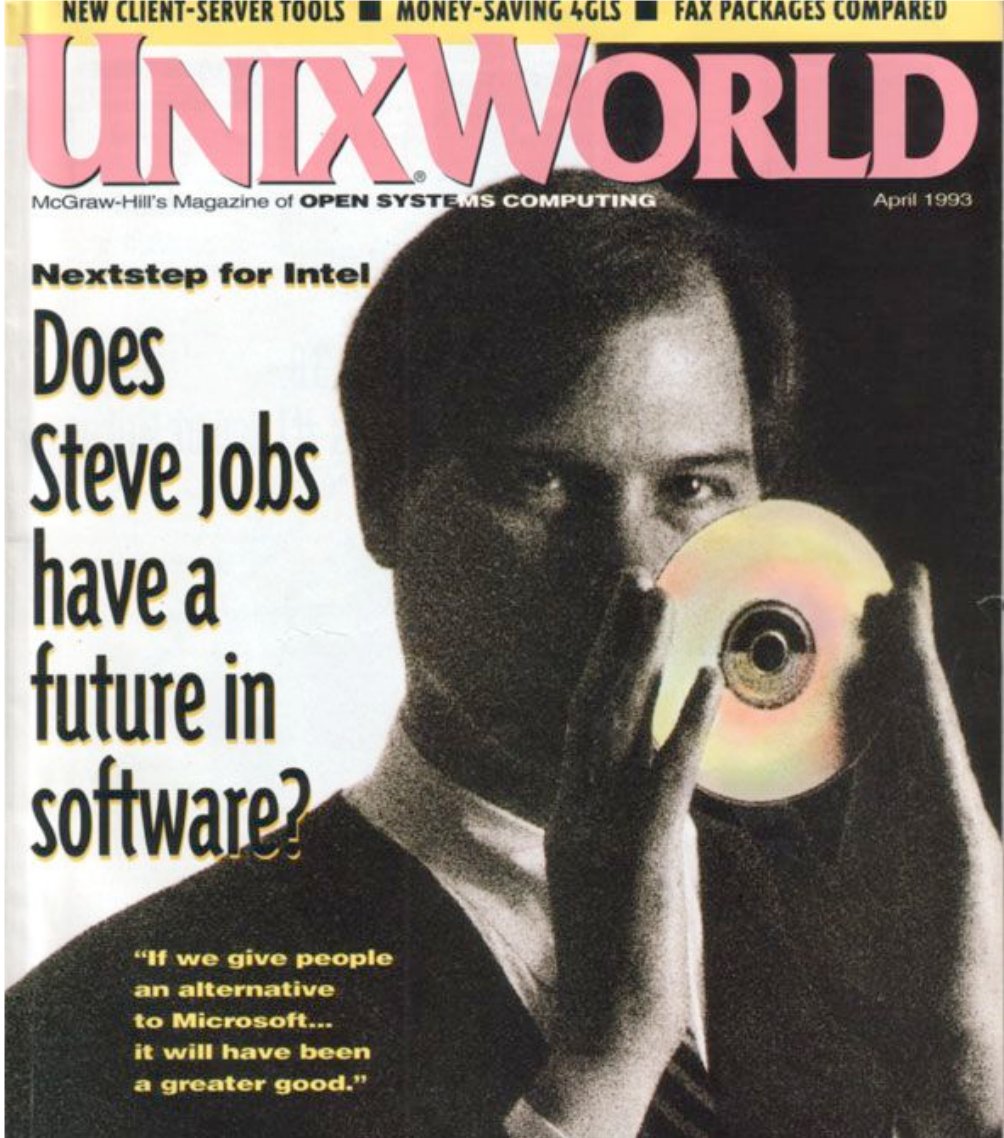
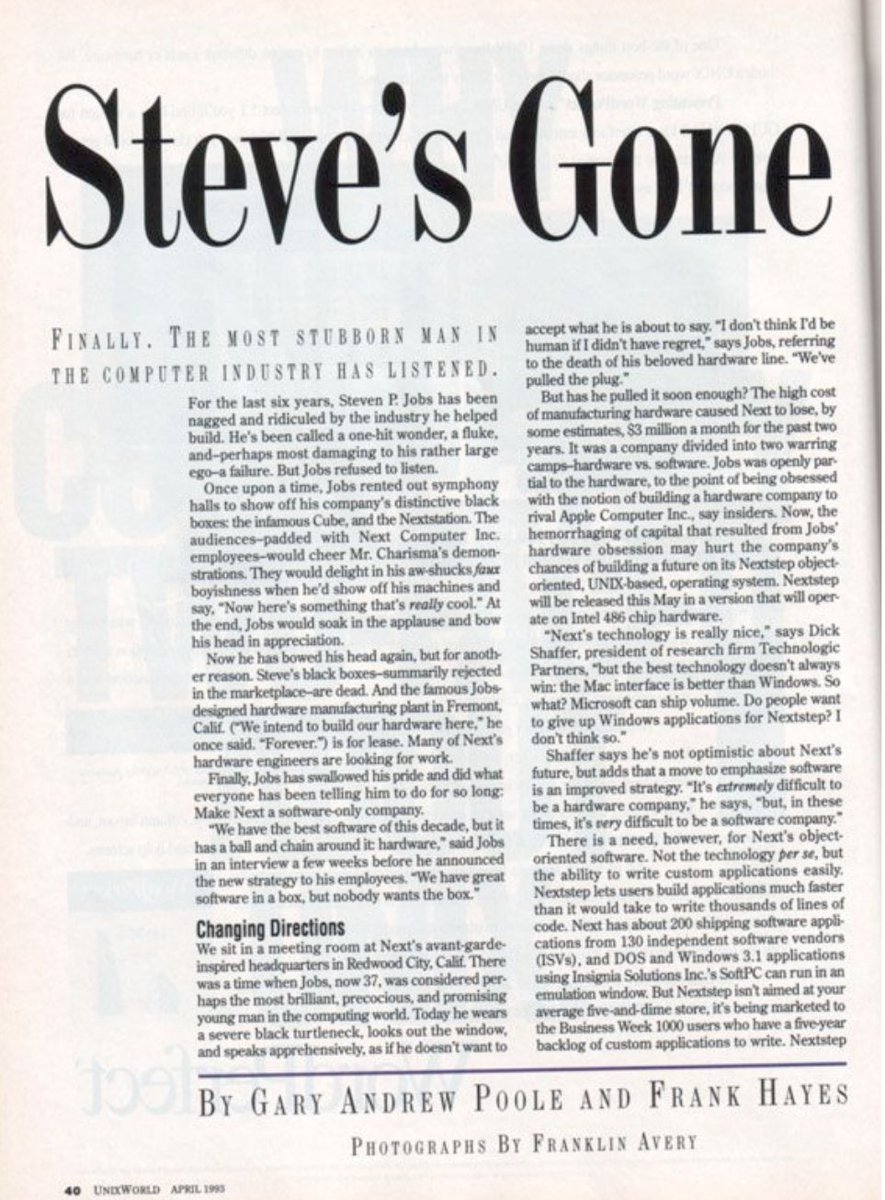
unix_byte's tweet image. In 1993, Steve Jobs was largely absent from public following his departure from Apple in 1985. Jobs had founded NeXT, a company that produced high-end Unix workstations, but it struggled commercially. The entry-level NeXT workstation was priced around $5,000—approximately $15,000…

Ken Thompson is best known for his work on Unix. However, shortly before Unix, Ken implemented one of the first practical regular expression engines (Communications of the ACM, 1968). Since then, regular expressions have become integral to many Unix tools, and today nearly every…
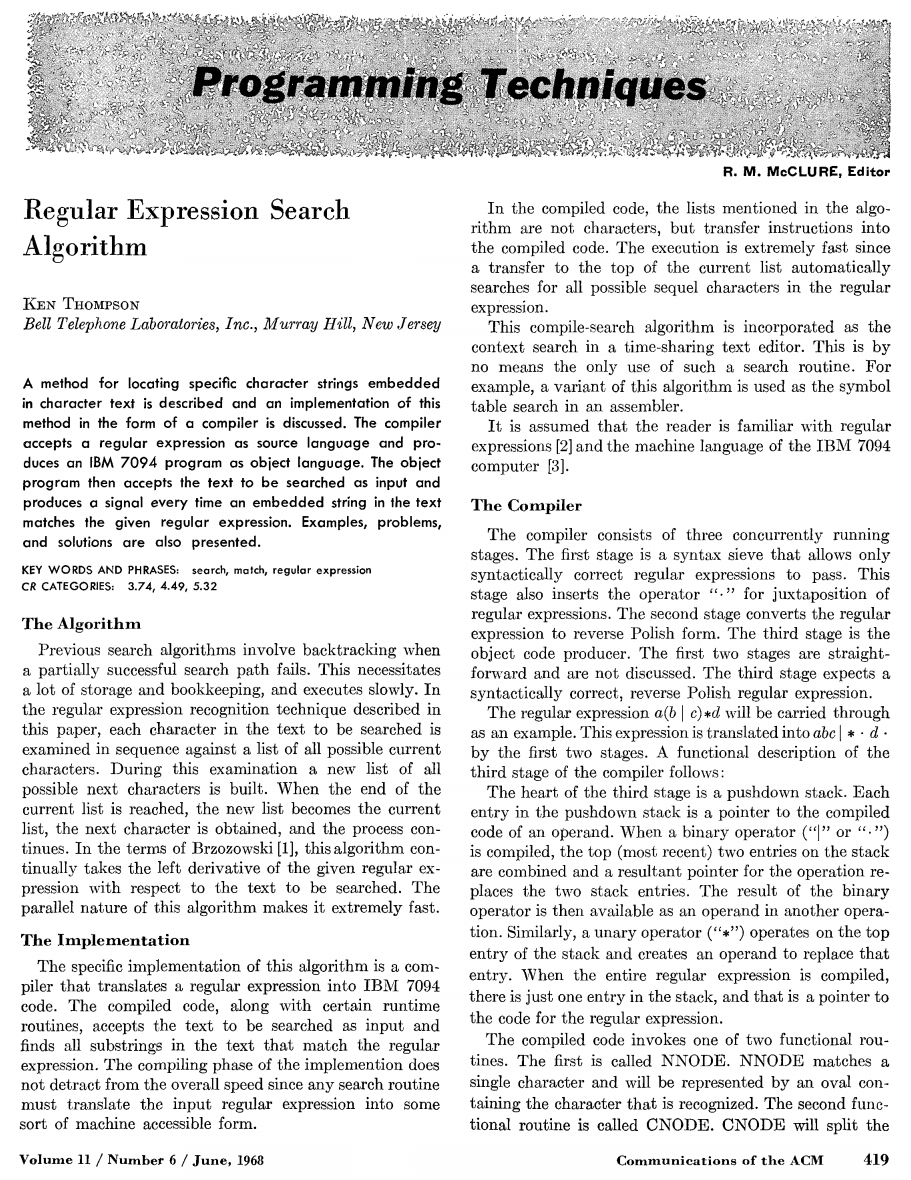
unix_byte's tweet image. Ken Thompson is best known for his work on Unix. However, shortly before Unix, Ken implemented one of the first practical regular expression engines (Communications of the ACM, 1968). Since then, regular expressions have become integral to many Unix tools, and today nearly every…

In 1983, Unix was already recognised for its elegance and portability. However, at the time, Unix's use was primarily academic and institutional; the broader open-source movement, including Linux and FreeBSD, was still years away. The August 1983 issue of BYTE was a special…

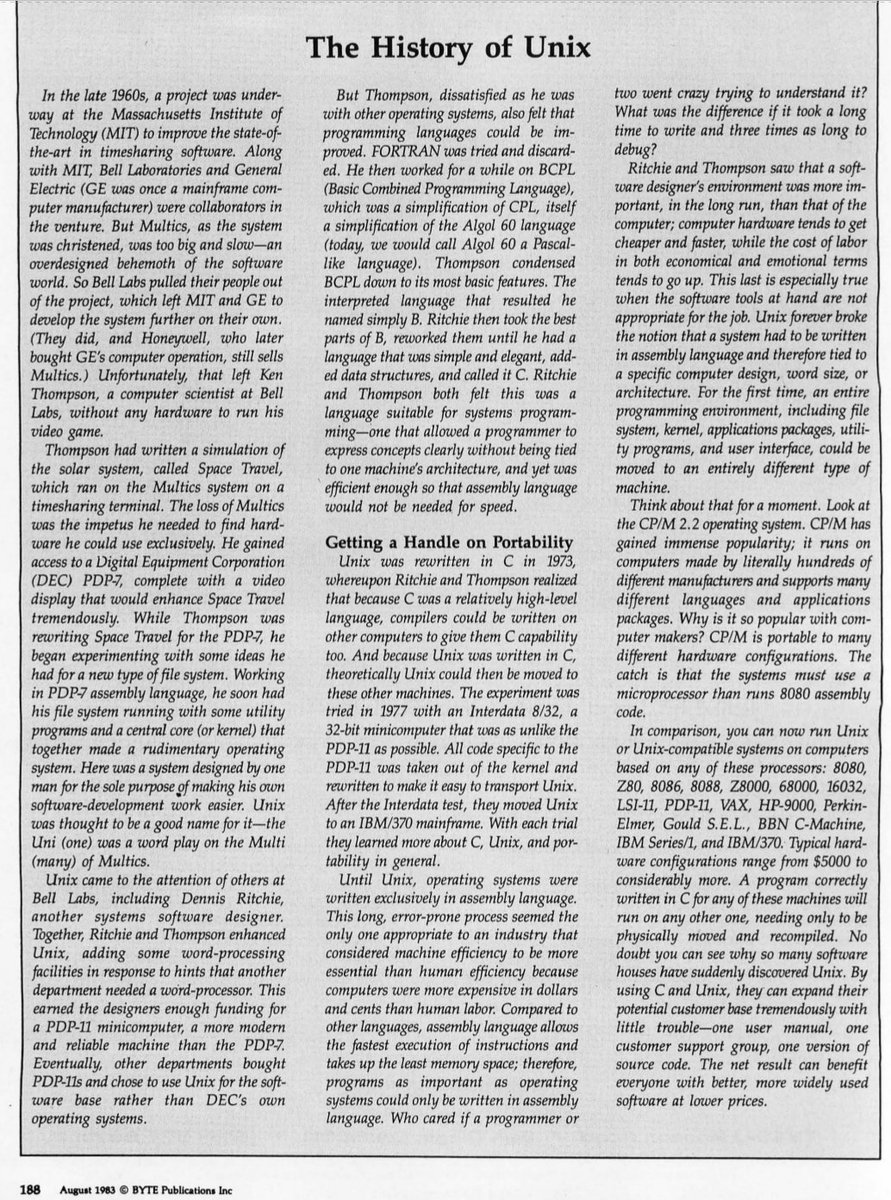
unix_byte's tweet image. In 1983, Unix was already recognised for its elegance and portability. However, at the time, Unix's use was primarily academic and institutional; the broader open-source movement, including Linux and FreeBSD, was still years away. The August 1983 issue of BYTE was a special…

"I actually have no good idea at all...I guesstimate a user base of about 50,000 active users: that may be way off-base, but it doesn't sound too unlikely." Linus Torvalds answering Linux Journal on what his best guess was for Linux use in 1994 x.com/nixcraft/statu…

Linux kernel creator Linus Torvalds in 1994

nixcraft's tweet image. Linux kernel creator  Linus Torvalds in 1994


The clip from Computerworld (January 1981) reported that AT&T considered the Unix operating system a “scrap material”. Certain Jerry Dreyer, president of the Association of Data Processing Services Organizations, noted, "But this 'scrap' has sold well to academic users around…

unix_byte's tweet image. The clip from Computerworld (January 1981) reported that AT&T considered the Unix operating system a “scrap material”.  Certain Jerry Dreyer, president of the Association of Data Processing Services Organizations, noted, "But this 'scrap' has sold well to academic users around…

The following news item appeared in BYTE, January 1980. The Association of Data Processing Service Organizations (ADAPSO) — a trade association representing companies that provided computer services — petitioned the U.S. Department of Justice to take action against AT&T for…

unix_byte's tweet image. The following news item appeared in BYTE, January 1980. The Association of Data Processing Service Organizations (ADAPSO) — a trade association representing companies that provided computer services — petitioned the U.S. Department of Justice to take action against AT&T for…

Loading...

Something went wrong.


Something went wrong.