
#stringfunctions نتائج البحث

split(str, [delimiter]) splits strings/vectors—auto-CHAR vec if no delimiter! ✂️Use a delimiter for CHAR/STRING vecs; vector input returns columnar tuples. Ideal for text parsing. #DolphinDB #StringFunctions #TextParsing
rpad(str, length, [pattern]) pads strings on the right with your chosen pattern! 🧩Reach the target length easily—great for text alignment or standardizing string formats. #DolphinDB #StringFunctions #TextFormatting
![DolphinDB_Comm's tweet image. rpad(str, length, [pattern]) pads strings on the right with your chosen pattern!
🧩Reach the target length easily—great for text alignment or standardizing string formats.
#DolphinDB #StringFunctions #TextFormatting](https://pbs.twimg.com/media/G6l6Oh4aQAERAI_.png)
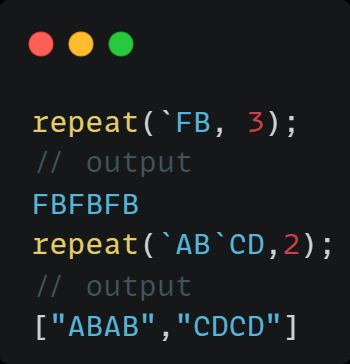
repeat(X, n) returns the string X repeated n times! 🔁 Super simple for duplicating text—ideal for quick string generation or pattern creation. #DolphinDB #StringFunctions #TextGeneration
lpad(str, length, [pattern]) pads strings (or table string cols) on the left! 🧩Ignores non-string columns—customize padding with an optional pattern. Perfect for text alignment. #DolphinDB #StringFunctions #TextFormatting
![DolphinDB_Comm's tweet image. lpad(str, length, [pattern]) pads strings (or table string cols) on the left!
🧩Ignores non-string columns—customize padding with an optional pattern. Perfect for text alignment.
#DolphinDB #StringFunctions #TextFormatting](https://pbs.twimg.com/media/G6MIx_caIAA_evS.png)
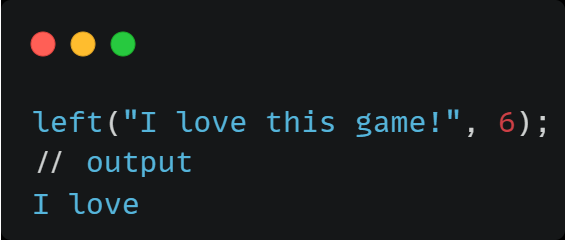
left(X, n) grabs the first n characters of X! ←Works on strings + table string columns (ignores other column types). Perfect for quick text slicing. #DolphinDB #StringFunctions #DataSlicing
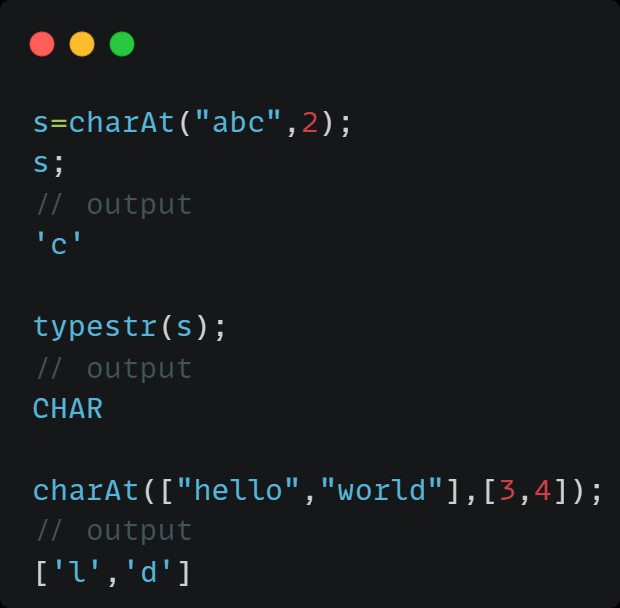
charAt(X, Y) fetches the character at position Y in string X! 🔍 Returns a CHAR type—handy for precise string slicing and text parsing tasks. #DolphinDB #StringFunctions #TextProcessing
charAt(X, Y) fetches the character at position Y in string X! 🔍 Returns a CHAR type—handy for precise string slicing and text parsing tasks. #DolphinDB #StringFunctions #TextProcessing

SQL Tip of the Day: Use LEFT & RIGHT to Extract Fixed-Length Strings SELECT LEFT(postal_code, 3) AS RegionCode FROM Addresses; Simple way to extract string chunks without SUBSTRING(). #SQLTips #StringFunctions #LearnSQL #TSQL
SQL Tip Of The Day Use REVERSE() to Flip Strings SELECT REVERSE('SQL'); -- Outputs LQS Niche, but fun and sometimes useful. Ever had to reverse strings? #SQLTips #StringFunctions #LearnSQL

String Functionalities in JavaScript Image Credit: Codewithsoloba

SQL Tip Of The Day Use PATINDEX for Pattern Search in Strings SELECT PATINDEX('%@%.com%', email) FROM Users; Similar to LIKE but returns position. Use it for validations? #SQLTips #StringFunctions #DataQuality #LearnSQL

📅 PHP Coding Tips - Day 91 ❗️Use str_contains() for Clean String Checks 🔍 ✅ Available since PHP 8. ❓ Still using strpos()? #PHP #ModernPHP #StringFunctions #100DaysOfPHP


"String Theory" for(float i,z=fract(dot(FC,sin(FC))),d;i++<1e2;){vec3 p=z*normalize(FC.rgb*2.-r.xyy);p.z+=9.;for(d=.7;d<4.;d/=.9)p+=cos(p.yzx*d-t/vec3(2,1,5))/d;z+=d=.002+abs(p.z)/2e1;o+=(sin(z+4.*p.z+vec4(0,1,5,0))+1.2)/d;}o=tanh(o/1e4);

#Attached are the visualizations I practiced with today. @tableau #TableauTips #StringFunctions #DataPreparation #AnalyticsJourney

Python f-strings explained How to use f-strings for different operations in Python youtu.be/TEjoq7dmdW4


2. Calculating the Number of Days Since Each Sale – I also wrote a query to calculate how many days ago each sale happened. Here’s the solution: #SQL #DataAnalytics #StringFunctions #DateFunctions #DataCleaning #SQLChallenge #LearningJourney #TechJourney #DataWrangling



This little utility function is one of the most important things in the whole Tailwind CSS v4 codebase — we use it all over the place. Used in lots of tight loops too so it's important that it's fast — did you know maintaining a stack as a string is faster than using an array?


💡🐍 We have 𝚏-strings in Python since 3.6 Let's have a look at their powerful features 👇


🔷 About Javascript strings and string methods in brief ↓ A MEGA Thread 🧵 :

Something went wrong.
Something went wrong.
United States Trends
- 1. Notre Dame 94.3K posts
- 2. Tulane 32.4K posts
- 3. Miami 415K posts
- 4. Daniel Jones 4,000 posts
- 5. Redzone 11.2K posts
- 6. #CFPRankings 2,340 posts
- 7. #HardRockBet 3,731 posts
- 8. Pearl Harbor 49.3K posts
- 9. #CFBPlayoff 10.6K posts
- 10. ESPN 79.8K posts
- 11. #HereWeGo 1,686 posts
- 12. Tee Higgins 3,118 posts
- 13. Titans 15.4K posts
- 14. Aaron Rodgers 3,042 posts
- 15. Texas 200K posts
- 16. Riley Leonard N/A
- 17. Oregon 34.6K posts
- 18. Brady Cook N/A
- 19. Canes 14.8K posts
- 20. Ty Johnson N/A